jump to content jump to footer

Categories: mintLesion

PET scans of torso with relevant false positives highlighted by red dotted circles, true positives in green
Representative prediction pitfalls in cases with high DSC
LMU University Hospital: Artificial Intelligence for TNM Staging in NSCLC – How Reliable Are AI-Based Segmentations?

The recent study “Artificial intelligence for TNM staging in NSCLC – a critical appraisal of segmentation utility in [¹⁸F]FDG PET/CT” provides a…

Read more
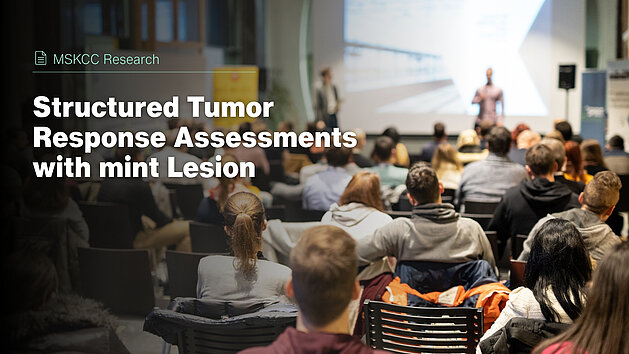
Participants at the RECIST and Beyond workshop in Cologne during hands-on training with mint Lesion for structured tumor response assessment.
The two-day “RECIST and Beyond” workshop at radCIO Cologne offered intensive hands-on training on RECIST, iRECIST, mRECIST and LI-RADS, with real-case reporting performed directly in mint Lesion.
Successful “RECIST and Beyond” Workshop in Cologne: Advancing Precision in Oncologic Imaging

How can complex tumor findings be assessed accurately, reproducibly, and in line with clinical guidelines?

Read more
Screenshot of the mint Lesion interface showing RANO 2.0 configuration, tumor burden calculations, and structured neuro-oncology assessment tools.
mint Lesion fully supports RANO 2.0 implementation with configurable parameters, automated tumor burden calculations, and structured workflows for neuro-oncology clinical trials.
Implementing RANO 2.0 for Neuro-Oncology Clinical Trials in mint Lesion

Tumor response assessment in neuro-oncology clinical trials requires careful attention to measurement protocols and confirmation scan requirements. To…

Read more
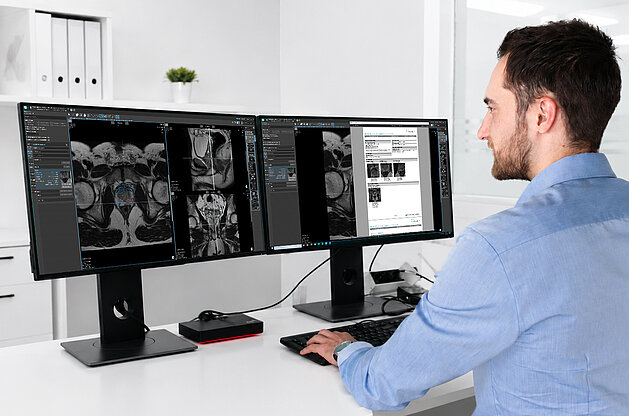
Image of doctor looking at a prostate in mint Lesion.
Prof. Dr. Thorsten Persigehl from University Hospital Cologne discusses the use of structured reporting and AI in prostate diagnostics with mint Lesion.
Structured Reporting and AI in Radiology: Efficiency and Quality in Prostate Diagnostics

How are structured reporting and artificial intelligence transforming radiology practice?

Prof. Dr. Thorsten Persigehl from University Hospital…

Read more
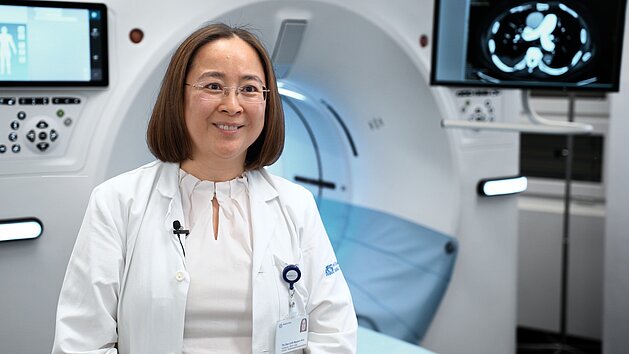
Dr. Madelaine Hettler from University Medical Center Mannheim discusses the RACOON-SAGA project and how it improves sarcoma diagnostics.
The interdisciplinary research project RACOON-SAGA combines functional MRI data and clinical information to enhance the pre-therapeutic characterization of soft tissue sarcomas.
Rare Tumors, Big Goals: How RACOON-SAGA Aims to Improve Therapy Decisions

Rare tumors, major challenges: The RACOON-SAGA project explores how imaging and clinical data can improve the pre-therapeutic characterization of soft…

Read more
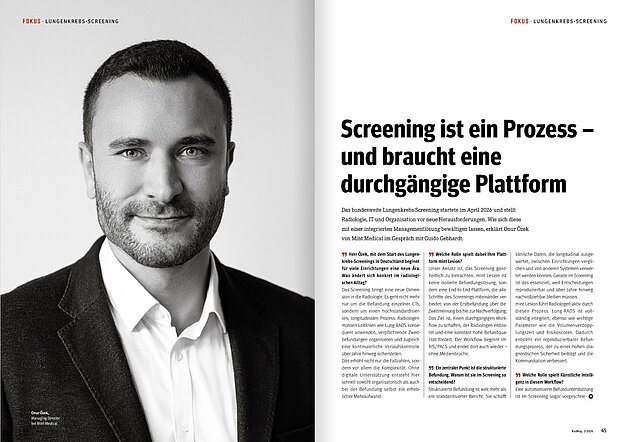
Portrait of Univ.-Prof. Dr. Thorsten Persigehl, expert in oncologic imaging at University Hospital Cologne
“Structured reporting and AI are transforming prostate diagnostics—enhancing precision and efficiency.”
Structured Reporting and Artificial Intelligence in Prostate Diagnostics: An Interview with Prof. Dr. Thorsten Persigehl

What does radiology look like when structured reporting meets artificial intelligence? A look into the daily practice of Prof. Dr. Thorsten Persigehl…

Read more
Image of Dr. Madelaine Hettler during interview on RACOON-SAGA: interdisciplinary project using MRI parameters (ADC) and clinical data to improve therapy decisions in sarcomas.
In this interview, Dr. Madelaine Hettler explains how functional MRI data—especially ADC—are linked with clinical parameters, why interdisciplinary teamwork matters, and how the study builds robust evidence despite rare cases.
RACOON SAGA: Interdisciplinary Research for Better Therapy Decisions in Sarcoma Treatment

Sarcomas are rare tumors that pose particular challenges to both medicine and research. Their heterogeneity makes precise diagnostics difficult, which…

Read more
scroll-top