jump to content jump to footer

Categories: mintLesion

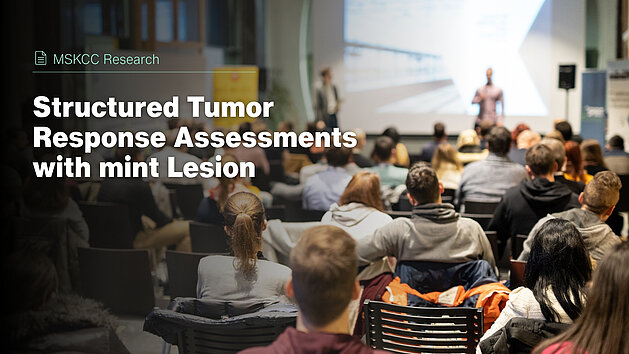
Research poster presentation on standardized tumor response assessments using mint Lesion at the NCCN Annual Conference 2026
Presentation of a research poster by Memorial Sloan Kettering Cancer Center on the use of mint Lesion for structured tumor response assessments and clinical research workflows.
NCCN 2026: Memorial Sloan Kettering Cancer Center Presents Research on Structured Tumor Response Assessments with mint Lesion
Big congratulations to Steven Philemond and Alison Chiaramonte of Memorial Sloan Kettering Cancer Center for presenting their research poster “Use of…
Read more
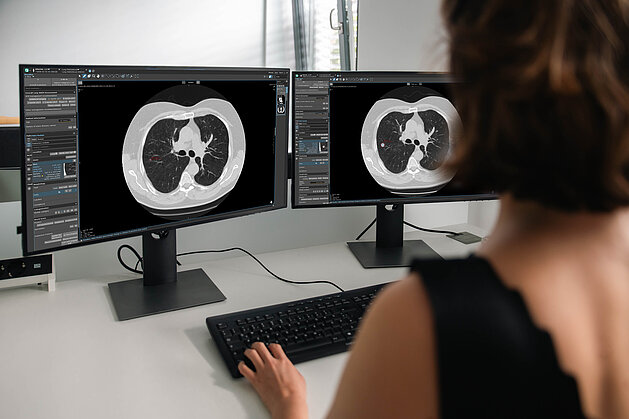
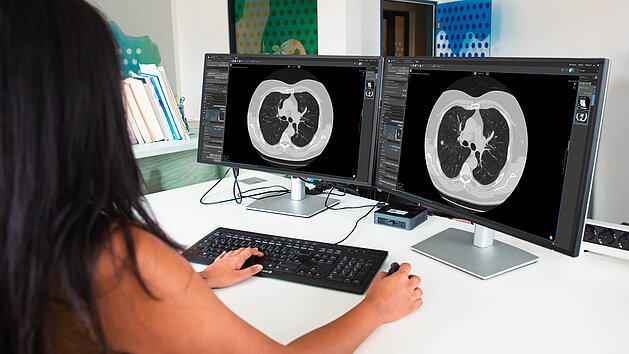
Radiologist using mint Lesion for structured reporting and AI-supported workflows in lung cancer screening
How radiology practices can participate in lung cancer screening in Germany with mint Lesion through structured reporting, AI-supported workflows, and integrated collaboration with second-reading centers.
How Radiology Practices Can Participate in Germany’s Lung Cancer Screening Program with mint Lesion
New opportunities - but also economic uncertainty With the launch of lung cancer screening (LCS) in Germany, radiology practices are facing a new…
Read more
Hospital staff using mint Lesion for interoperable workflows and data management in lung cancer screening
How mint Lesion supports hospitals and screening centers with interoperable infrastructure, AI integration, data management, and scalable workflows for lung cancer screening.
Lung Cancer Screening in Germany: How mint Lesion Supports Hospitals with Infrastructure, Integration, and Scalability
Screening as a Strategic Challenge With the launch of the national lung cancer screening program in 2026, hospitals and screening centers across…
Read more
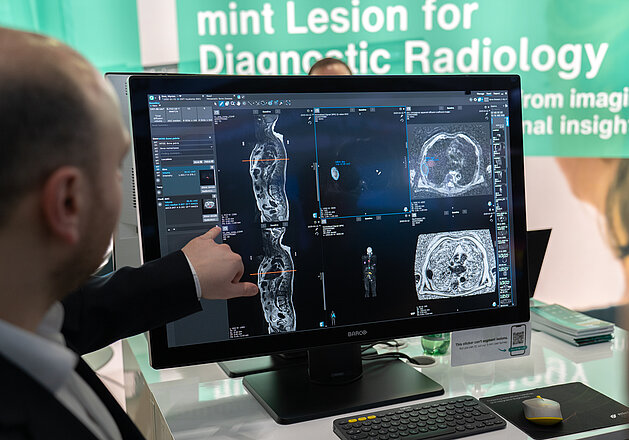
Radiologist analyzing whole-body MRI scans of prostate cancer bone metastases using AI-assisted tumor load quantification in mint Lesion
How mint Lesion supports radiologists in AI-assisted tumor load quantification for bone metastases in prostate cancer with structured analysis, objective metrics, and longitudinal therapy assessment.
AI-Supported Tumor Load Quantification for Bone Metastasis in Prostate Cancer
To assess treatment response in patients with advanced prostate cancer, radiologists rely on advanced medical imaging. Conventional modalities, such…
Read more
Radiologists participating in a hands-on lung cancer screening workshop using structured reporting software mint Lesion at RÖKO 2026
Interactive hands-on workshop on lung cancer screening according to G-BA guidelines at RÖKO 2026, including structured reporting, double reading workflows, and consensus decision-making
Hands-On Workshop Lung Cancer Screening: From Initial Read to Consenus
From initial read to consensus – structured reporting in practice at RÖKO 2026
Read more
Radiologist analyzing whole-body MRI scans of multiple myeloma using AI-assisted quantification in mint Lesion
How mint Lesion supports radiologists in AI-assisted quantification of bone involvement in multiple myeloma with structured analysis, objective metrics, and longitudinal disease tracking.
AI-Supported Quantification of Bone Involvement in Multiple Myeloma
Radiologists utilize Whole-Body MRI (WB-MRI) as an established imaging method for multiple myeloma staging [1,3]. Because it avoids ionizing…
Read more
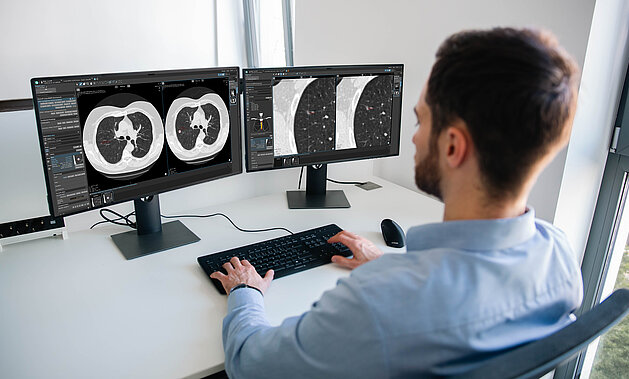
Radiologist using mint Lesion for structured lung cancer screening reporting and AI-assisted lung nodule assessment
How mint Lesion supports radiologists in the German lung cancer screening program through structured reporting, AI-supported workflows, second reading, and longitudinal patient follow-up.
Lung Cancer Screening in Germany: How mint Lesion Supports Radiologists in Clinical Practice
A New Era of Early Detection — and New Challenges With the introduction of the nationwide lung cancer screening program starting in 2026,…
Read more
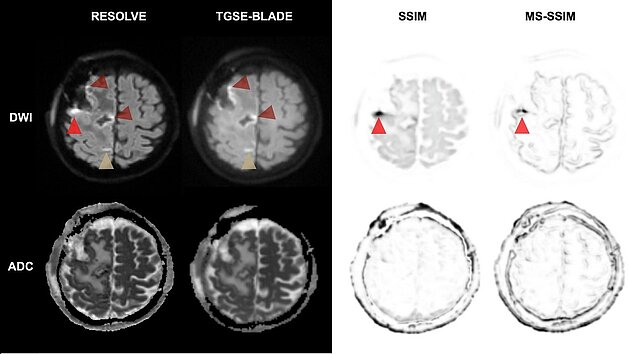
Postoperative brain tumor MRI comparing TGSE-BLADE and RESOLVE DWI showing distortion reduction near resection site
A recent study published in the European Journal of Radiology compares TGSE-BLADE DWI with RESOLVE DWI in postoperative brain tumor imaging. TGSE-BLADE demonstrated significantly reduced geometric distortion and artifacts caused by intracranial air, enabling more accurate detection of ischemic changes and improving diagnostic confidence in early postoperative MRI.
University Hospital Tübingen: Improving Postoperative Brain Tumor MRI: TGSE-BLADE vs. RESOLVE DWI
Early MRI scans are critical for patients who have just undergone brain tumor resection to evaluate the surgery's success and plan future treatments.…
Read more
scroll-top