jump to content jump to footer
Radiologist using mint Lesion for structured reporting and AI-supported workflows in lung cancer screening

How Radiology Practices Can Participate in Germany’s Lung Cancer Screening Program with mint Lesion

New opportunities - but also economic uncertainty

With the launch of lung cancer screening (LCS) in Germany, radiology practices are facing a new opportunity: additional revenue through extrabudgetary reimbursement. In other words, practices that process more cases may also generate additional revenue.

For practices with underutilized CT capacity in particular, this creates an attractive opportunity to examine additional patients and make better use of existing infrastructure.

At the same time, key uncertainties remain:

  • How many participants will actually enroll?
  • How strongly will regional demand fluctuate?
  • Will the investment pay off in the long term? 

As a result, many practices are facing the same question: How can we participate in screening without taking on significant financial risk?


The Core Challenge: High Initial Costs with Uncertain Utilization

To participate in LCS, practices require not only a suitable CT scanner, but also the appropriate technological infrastructure.

In practice, this often includes:

  • investments in AI software
  • additional hardware (e.g., high-performance GPUs)
  • IT integration and ongoing maintenance
  • software subscriptions 

These initial investments can quickly reach five-figure amounts, while future case volumes remain uncertain.

This represents a considerable risk, particularly for privately owned practices or smaller imaging groups. In addition, many practices do not have dedicated in-house IT departments and may need to involve external service providers.

As a result, practices require solutions that are cost-efficient, easy to integrate, and ready for immediate use.

Low Entry Barriers Through Centralized Deployment

Mint Medical addresses this challenge with an approach specifically designed for screening networks: the technical infrastructure is provided by the second-reading center.

For primary reading centers (radiology practices), this means:

  • no major upfront investments in hardware or IT
  • no complex on-site installation
  • no additional maintenance effort
  • fast onboarding into the screening program 

This allows practices to focus on what matters most: performing examinations and reporting efficiently.

Making Meaningful Use of Existing Capacity

For many practices, utilization of existing imaging systems is a key economic factor. Lung cancer screening offers a concrete opportunity through additional examinations outside budget limitations, predictable processes based on standardized workflows, and potentially higher utilization of existing CT systems.

Particularly in regions with high participation rates, screening may help increase practice productivity. In combination with an affiliated second-reading center, this creates a functional network capable of processing additional cases efficiently.

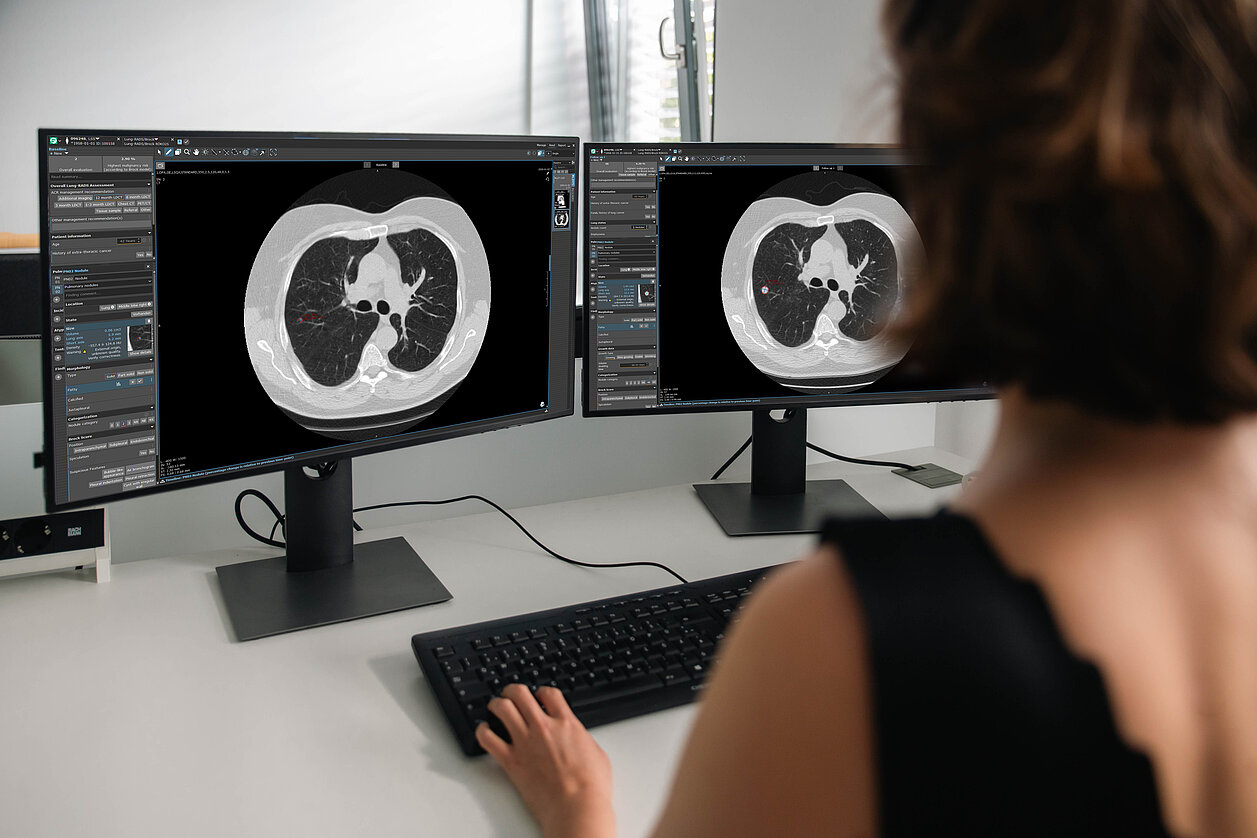
To help practices make meaningful use of additional capacity, mint Lesion supports radiology institutions through:

  • structured, guideline-based reporting
  • display and review of AI-generated lung nodule detection and segmentation results
  • direct editing and validation of AI-generated findings
  • automatic updating of Lung-RADS assessments based on radiologist modifications 

Collaboration with Second-Reading Centers

Mandatory second reading is a fixed component of LCS — and at the same time a potential bottleneck.

mint Lesion supports collaboration between primary and secondary readers through automated exchange of imaging and reporting data, synchronized workflows between institutions, and a traceable consensus workflow.

Interoperability for Growing Practice Networks

Larger radiology groups in particular face additional requirements:

  • integration into existing IT environments
  • standardized processes across multiple sites
  • centralized coordination combined with decentralized execution 

mint Lesion supports these requirements through:

  • integration into existing RIS/PACS systems
  • flexible infrastructure models
  • cross-site workflows 

This makes the platform a scalable solution for screening, even for larger organizations.

Lung cancer screening offers radiology practices a new opportunity: additional revenue through extrabudgetary reimbursement as well as the potential for better utilization of existing resources. At the same time, participation requires careful consideration of costs, risks, and efficiency.

mint Lesion supports practices in getting started with lung cancer screening. This allows radiology institutions to integrate screening workflows pragmatically into their daily routine.

If you would like to learn more, speak with one of our experts.

You may also be interested in our related articles:

scroll-top