Sarcomas are a rare and highly diverse group of malignant tumors that affect both soft tissue and bones, posing significant challenges due to their variety and complexity in treatment.
At LMU Munich, intensive efforts are underway as part of the Bavarian Oncological Radiology Network (BORN) to develop standardized reporting templates for the radiological diagnosis and treatment of sarcomas. These structured templates are being systematically developed and will later be shared with other clinics participating in the BORN project. The goal is to significantly improve the consistency and efficiency of radiological diagnoses.
This collaborative development and application of such reporting templates is a central part of the network, which is now in its second funding phase. In a previous interview, we we reflected on the project's early stages and spoke with Dr. Maurice Heimer from the Department of Radiology at LMU Klinikum about the development of a lung reporting template.
In this interview, we shift our focus to the second phase to learn more about the challenges and opportunities in creating reporting templates for sarcomas. We sat down with Prof. Dr. Wolfgang Kunz from LMU Munich to discuss this in more detail.
Prof. Kunz, why did you choose to focus on sarcomas?
Patients with sarcomas present a unique clinical challenge. In oncological imaging, sarcomas appear highly heterogeneous and behave differently from other solid tumors. This affects both local staging and the assessment of treatment response, highlighting the need for standardization—something we were able to achieve with mint Lesion™.
Key challenges in diagnosing and treating sarcomas necessitate a high level of interdisciplinarity: treatment often requires collaboration across various disciplines. Additionally, sarcomas are rare, accounting for less than 1% of all cancer cases. Furthermore, there is a wide range of subtypes, requiring very different treatment approaches.
Standardizing the reporting process is therefore not only helpful but, from our perspective, almost essential. LMU also possesses extensive interdisciplinary expertise and state-of-the-art equipment for the diagnosis and treatment of sarcomas, which is why we adopted these templates.
Sarcomas are a heterogeneous group of malignant tumors. What is the biggest challenge for you in defining a reporting template for all soft tissue and bone sarcomas?
Sarcomas in different anatomical locations can vary greatly in terms of phenotype and tumor behavior, making it impossible for one template to capture this complexity. Therefore, it is necessary to tailor templates to specific sarcoma groups. We decided to start with a reporting template for visceral sarcomas in the retroperitoneum and are planning additional templates, specifically for extremity sarcomas.
What are you most looking forward to once the reporting template is created and used?
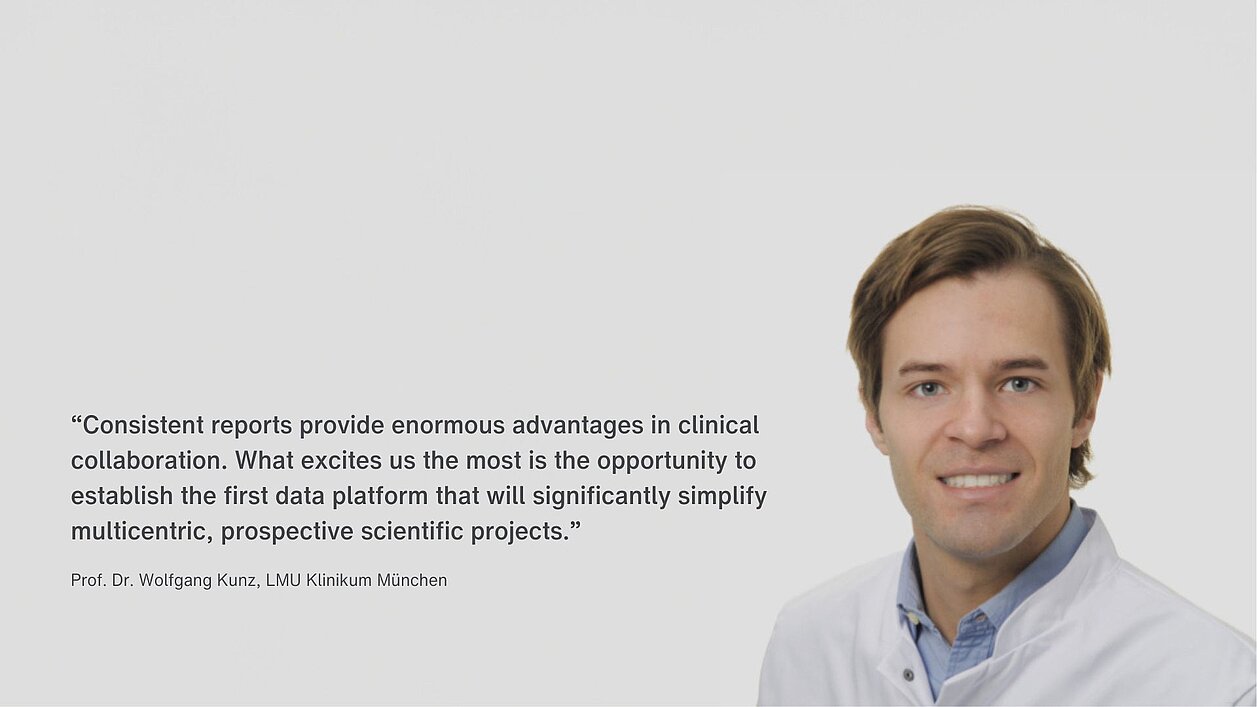
We are particularly excited about the standardized data collection and reporting. Consistent reports provide enormous advantages in clinical collaboration. What excites us the most is the opportunity to establish the first data platform that will significantly simplify multicentric, prospective scientific projects.
Prof. Dr. Wolfgang Kunz, MHBA, is the Head of Oncologic Imaging and Director of the Center for Collaborative Studies. His clinical and research focus is on oncologic and neurovascular imaging. In addition to imaging research, he is also interested in cost-effectiveness analysis of diagnostic imaging algorithms and therapeutic interventional radiology procedures.
Since its launch in August 2022, the BORN project has aimed to significantly enhance cancer care in Bavaria through standardized imaging and reporting. As part of the Bavarian Cancer Research Center (BZKF), a unified research and treatment platform is being developed, benefiting both patients and medical professionals across Bavaria.
The close collaboration of six university hospitals—in Augsburg, Erlangen, two sites in Munich, Regensburg, and Würzburg—brings together expertise in the early detection, treatment, and follow-up care of cancer. This ensures comprehensive and interdisciplinary care for all those affected.