jump to content jump to footer
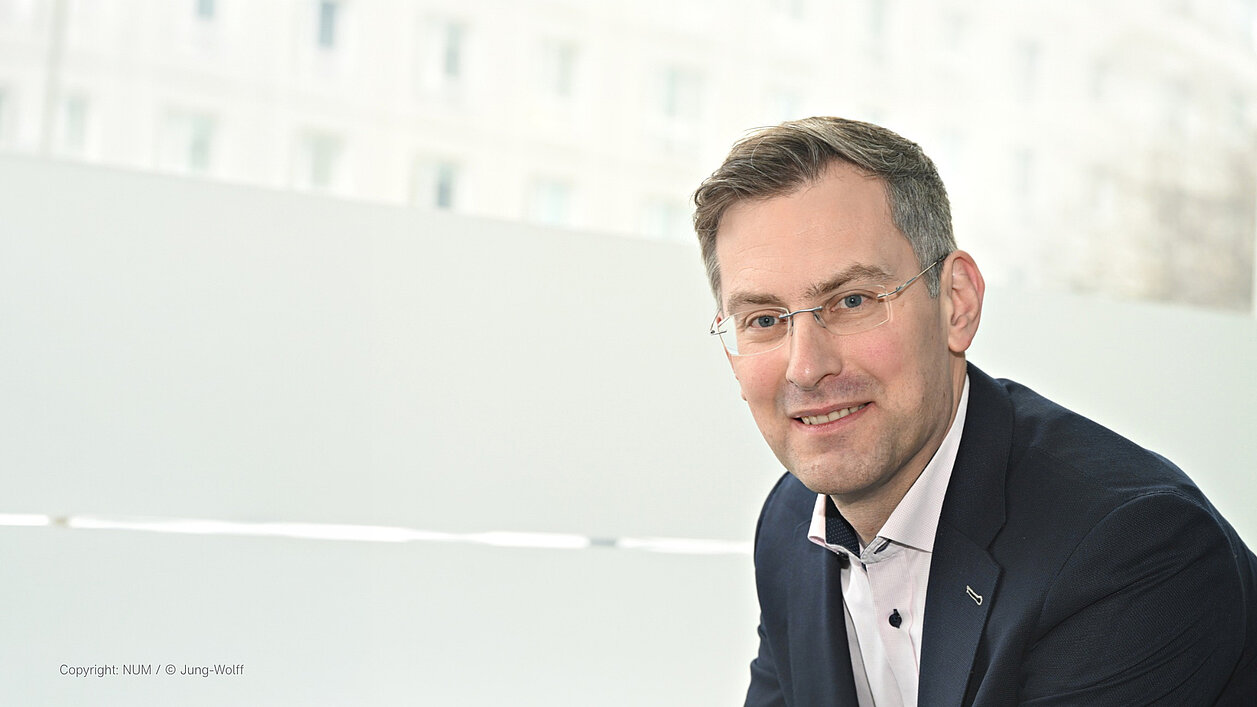
Portrait of Ralf Heyder, head of the NUM Coordination Office at Charité, interviewed at the RACOON Research Days in Tübingen

RACOON in the Network University Medicine

Ralf Heyder on collaborative imaging research

How Germany’s university hospitals built a shared platform for radiological imaging data, and what comes next

In early October 2026, representatives of the Network University Medicine (NUM), researchers and IT teams from the RACOON network, and technical partners came together at the RACOON Research Days in Tübingen. The focus was on where the project stands today, how it is evolving and the work that still lies ahead.

During the event, we spoke with Ralf Heyder, head of the NUM Coordination Office at Charité. In this short interview, he describes RACOON from the NUM’s perspective: what the network aims to achieve, what role RACOON plays in it, and where the platform is headed.

What is the NUM and what are its goals?

The Network University Medicine is an alliance of all 37 German university hospitals. They joined forces in clinical research in response to the COVID-19 pandemic, having realized that at the start of the pandemic, Germany was unable either to roll out large clinical trials or to bring together routine data from patient care at the national level. The network has now been working on these problems for more than six years. It has built solutions that will make large clinical trials and the nationwide use of patient data possible in the future.

What role does RACOON play in the NUM and what makes it stand out?

The Network University Medicine is building infrastructures for different types of medical data so that these data can be shared across all 37 sites. RACOON is one of these infrastructures. It specializes in imaging data, meaning MRI, CT and other large imaging datasets. It brings these data together and makes them available to researchers. What makes RACOON special is that it is the first platform of its kind in Germany and, to the best of our knowledge, unique worldwide, because 37 legally independent hospitals are voluntarily sharing their data.

Where does RACOON stand today and where is it headed?

Over the past six years, RACOON has shown that the approach of bringing all 37 university hospitals in Germany onto a shared platform for imaging data works. The challenge now is to turn a small number of successful research projects, already implemented within the NUM as a proof of concept, into many. In other words, to scale.

The second major topic: so far, the platform has mainly been used and developed by radiology. Now, other specialties are to be added, such as radiation oncology, nuclear medicine and pathology, so that Germany has a truly interdisciplinary platform for imaging research.
Ralf Heyder Interview: RACOON and NUM
Watch our video interview with Ralf Heyder on RACOON in the Network University Medicine on Youtube (English subtitles available).

The conversation shows where RACOON stands today: the shared infrastructure is established, and the focus is now on scaling up with more research projects and opening the platform to other imaging specialties. We would like to thank Ralf Heyder for the interview and look forward to continuing to support RACOON as it develops.

Mint Medical as a technical partner in RACOON

Mint Medical is a technical network partner in RACOON and supports the network with mint Lesion. mint Lesion forms the backbone of the RACOON infrastructure. It enables radiologists and physicians from other specialties to capture clinical information and imaging data in a structured, traceable and guideline-compliant way. Radiological findings are automatically turned into machine-readable, interoperable data, providing the basis for research, AI training and multicenter collaboration.

For more information about the Network University Medicine and RACOON, please contact the NUM Coordination Office or email forschungsnetzwerk-unimedizin@charite.de.
To learn more about mint Lesion, book a demo.

Integrated prostate cancer workflow connecting radiology, urology, and pathology through structured reporting, MRI-guided biopsy, longitudinal follow-up, and AI-supported analysis.
mint Lesion supports an end-to-end prostate cancer workflow by connecting radiology, urology, and pathology within a unified digital environment. The platform enables structured mpMRI reporting, MRI/ultrasound fusion biopsy workflows, FHIR-based interoperability, active surveillance, and AI-supported quantification of metastatic disease.
Be Central to the Insight: A Structured, Data-Driven Approach Across the Prostate Pathway
Digital Integration for Multidisciplinary Teams  In the complex journey of prostate cancer diagnostics, the data contributed by every department is…
Read more
Research poster presentation on standardized tumor response assessments using mint Lesion at the NCCN Annual Conference 2026
Presentation of a research poster by Memorial Sloan Kettering Cancer Center on the use of mint Lesion for structured tumor response assessments and clinical research workflows.
NCCN 2026: Memorial Sloan Kettering Cancer Center Presents Research on Structured Tumor Response Assessments with mint Lesion
Big congratulations to Steven Philemond and Alison Chiaramonte of Memorial Sloan Kettering Cancer Center for presenting their research poster “Use of…
Read more
Radiologist using mint Lesion for structured reporting and AI-supported workflows in lung cancer screening
How radiology practices can participate in lung cancer screening in Germany with mint Lesion through structured reporting, AI-supported workflows, and integrated collaboration with second-reading centers.
How Radiology Practices Can Participate in Germany’s Lung Cancer Screening Program with mint Lesion
New opportunities - but also economic uncertainty With the launch of lung cancer screening (LCS) in Germany, radiology practices are facing a new…
Read more
scroll-top