Establishing a Framework for Multicentric Data Coordination
For many investigators, the transition from a single-site study to a multicentric model introduces significant logistical shifts in data management. As research scales, the complexity of coordinating medical imaging data across different institutions increases. In this environment, the researcher’s role expands to include the coordination of data privacy protocols, standardized evaluation workflows, and regulatory oversight.
To maintain the scientific integrity of an IIT, a robust digital infrastructure is essential. mint Lesion provides a technical framework designed to support the lifecycle of multicentric imaging research through standardized processes.
1. Secure Image Acquisition and Consistent De-Identification
The first challenge in any multicentric study is the secure transfer of imaging data. mint Lesion provides a streamlined gateway for uploading DICOM files while prioritizing patient privacy.
- Automated De-Identification: Protected Health Information (PHI) is removed or pseudonymized during the upload process.
- Cross-Site Consistency: This ensures the central site receives images that are correctly de-identified in a consistent manner across all participating sites.
- Streamlined Uploads: A user-friendly interface designed to simplify the submission process for site staff.
2. Collaborative Research Hub
Multicenter IITs often struggle with fragmented communication, inconsistent processes and scattered imaging data. mint Lesion provides a single, secure environment where all sites, reviewers and coordinators collaborate within one centralized hub.
- Real-Time Data Exchange: Replaces physical media and fragmented email chains with a unified secure environment.
- Query Management: Standardized workflows to address discrepancies in image quality or clinical data directly within the platform.
- Progress Monitoring: Tracking study milestones and site performance through a unified dashboard.
3. Quality Assurance and Centralized Review
To maintain high data quality, mint Lesion enables centralized image review and quality assurance (QA) across all participating sites.
- Standardized Verification: Central reviewers can assess image quality and protocol adherence in real-time.
- Uniformity: Ensures that images from different centers meet the same technical requirements before they move to the evaluation phase.
4. Quantitative Image Evaluation
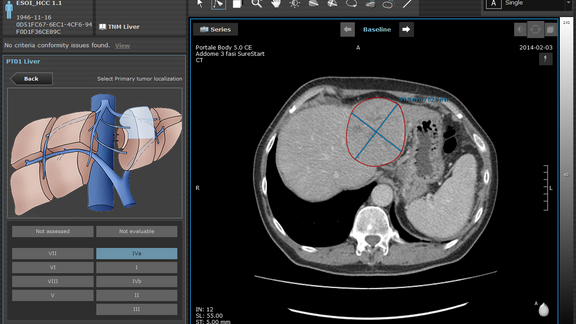
To ensure reproducible results, imaging endpoints must be assessed consistently across all sites. mint Lesion provides tools for standardized quantitative evaluation designed to reduce common research hurdles such as inter- and intra-reader variability and missing measurements.
- Structured and Customizable Reading Templates: Pre-built templates or custom Case Report Forms (CRFs) tailored to your protocol, with built-in quality control and conformity checks to help prevent protocol deviations.
- Longitudinal Tracking: Tools for the consistent tracking of lesions across multiple time points.
- Automated Assessments: mint Lesion generates response classifications (e.g., RECIST, Lugano, RANO, etc.) based on your measurements. Additionally, the platform supports advanced methodologies such as TGRM (Tumor Growth Rate Model) for kinetic analysis and Radiomics for the extraction of high-dimensional data features. This automation helps to minimize manual entry and calculation errors while expanding the depth of data analysis.
5. Structured Reporting and Data Management
mint Lesion generates structured radiology reports that organize complex findings into a format ready for analysis.
- Detailed Findings: Captures quantitative and qualitative data in a consistent framework.
- EDC Compatibility: Data Exportin csv and xml formats compatible with EDC systems for patient level and trial level analysis.
- Research Interoperability: Images/annotations are exportable in multiple formats including NRRD/NIFTI, DICOM-SC, DICOM-RT STRUCT, and DICOM-SEG for AI/Machine Learning.
6. Regulatory Compliance and Audit Readiness
Adherence to regulatory standards is non-negotiable in clinical research. mint Lesion is designed to support compliance with FDA and EMA requirements.
- 21 CFR Part 11 Ready Software: Comprehensive traceability of every action taken within the system, from upload to final evaluation and electronic signature standards.
- Data Governance: Ensuring that data handling meets industry standards for transparency and accountability.
7. Data Privacy and Security
The protection of sensitive trial information and patient privacy is a core component of the mint Lesion architecture. The following principles govern our approach to data sovereignty and regulatory adherence:
- Your Data Remains Yours: Mint Medical does not sell, share or otherwise commercialize any imaging data, annotations or evaluations performed within mint Lesion at sites.
- No Secondary Analytics or Learning on Your Cases: We do not train AI models, build datasets or perform internal research using your trial data unless a separate, explicit written agreement is in place.
- Regulatory and Confidentiality Compliance: Our software and processes adhere to applicable medical device and data protection regulations (e.g., HIPAA / GDPR), ensuring that protected health information is never repurposed or transferred without authorization.
Scalability for Evolving Research Requirements
mint Lesion is engineered to support research projects ranging from individual pilot studies to multi-trial programs. The core architecture allows for the expansion of research activities without the requirement to redesign IT infrastructure for every new protocol.
By integrating mint Lesion into the trial workflow, investigators can establish a consistent environment for data acquisition, centralized review, and regulatory documentation. This approach provides a stable foundation for multicentric collaboration, ensuring that the focus remains on the research objectives while the platform manages the underlying data complexity and compliance requirements.