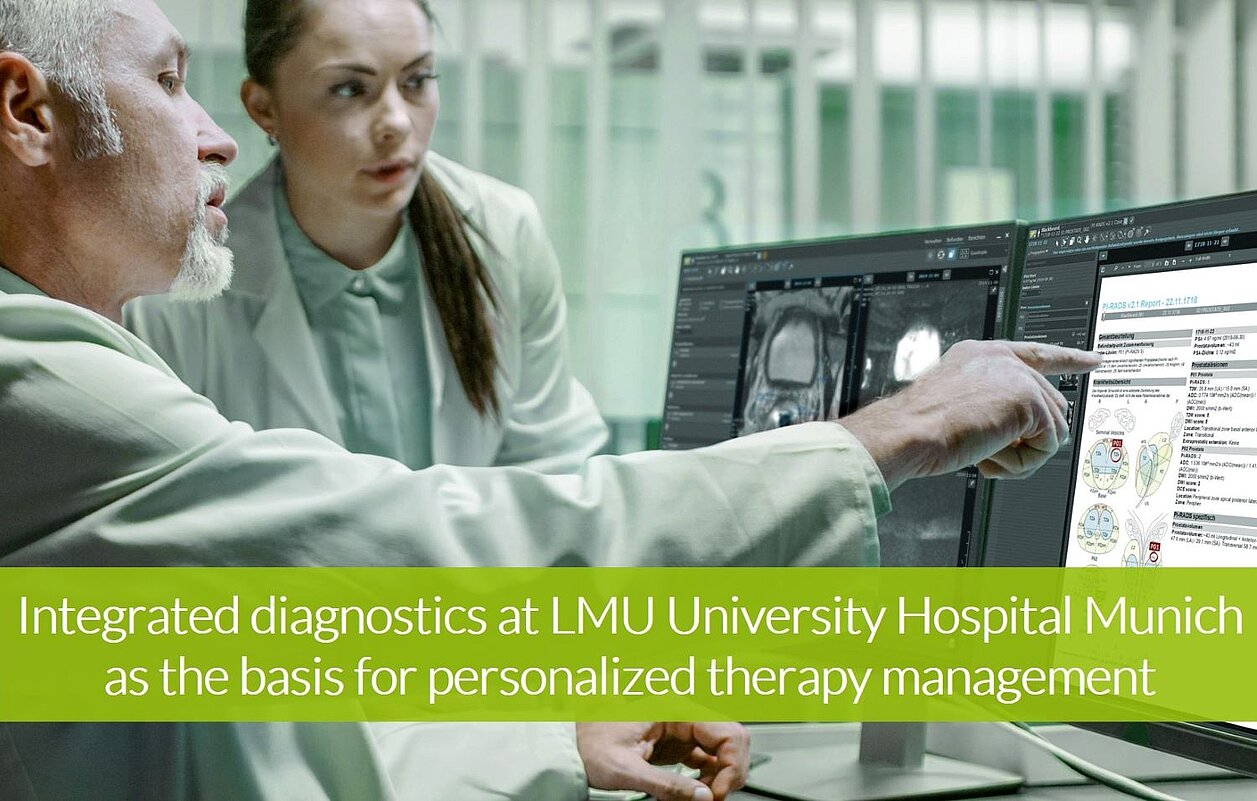
Integrated diagnostics at LMU University Hospital Munich as the basis for personalized therapy management
Heidelberg, GER – The long-standing cooperation between Mint Medical GmbH, developer of the leading radiological software platform mint Lesion™ for the standardization of radiological reads and context-driven structured reports, and the LMU University Hospital Munich is being expanded in regard to clinical routine. To date, mint Lesion™ has primarily been used at the hospital as a radiological assistant in clinical trials. With the expansion of use, the software platform will act as a gateway for closer interdisciplinary collaboration.
“We are using mint Lesion™ for structured radiological reads in clinical routine in order to immediately digitalize diagnostic information and make it accessible for automated analyses,” expressed Prof. Dr. Clemens Cyran, Chief Senior Physician of the Clinic and Polyclinic of Radiology. “In future, the digitalized and algorithm-accessible quantitative report data will serve as an essential source of diagnostic information together with laboratory, pathology, and other clinical data for integrated diagnostics as the basis for personalized therapy management”.
Data generated in mint Lesion™ is automatically integrated into a digital model of the patient and can be tracked over time. The software platform’s manifold uses range from image evaluation to information system to data generation, in order to enable the systematic, standardized acquisition of quantitative data, including its context. Embedding the software in the hospital-wide IT landscape supports the LMU University Hospital in establishing a cross-disciplinary data hub which achieves the intelligent networking of the various diagnostic methods.
Steffen Rupp, Sales Director at Mint Medical, describes the LMU University Hospital as “one of our longest-standing and most loyal partners, who has always been characterized by motivation, ambition and competence”. As a result of the expansion of use, their clinical trial excellence will now be extended to their clinical routine, allowing all patients to benefit from data-driven treatment decisions. “Once again, the LMU University Hospital is leading the way as one of the pioneers among university hospitals, and I am pleased that we at Mint Medical are able to accompany the hospital on this journey with our mint Lesion™ software platform”.
About Mint Medical
Mint Medical is a Heidelberg-based MedTech company with a focus on radiological software solutions that are used in clinical routine, clinical research and clinical trials worldwide. mint Lesion™, the company's core product, is an intuitive software for standardized and computer-aided evaluation of radiological and clinical data according to defined protocols, guidelines, and workflows. The certified medical product is used by university hospitals, cancer centers, and private practices, as well as contract research organizations, pharmaceutical and biotechnology companies in the areas of radiology and oncology.