Radiology reports are often the key to a diagnosis – and the way they are created and communicated makes a crucial difference.
Traditional free-text reports are often inconsistent, difficult to compare, and open to interpretation. Different writing styles or vague phrasing can reduce clarity and make it harder for referring physicians to identify the truly relevant information [1].
The solution?
Structured reporting. It creates clarity, standardization, and turns radiology reports into valuable data.
What is Structured Reporting?
Structured reporting means that medical reports are created based on predefined templates that guide radiologists step by step through the reporting process. These templates are aligned with current clinical guidelines and ensure that no essential information is missed.
The result is standardized reports that support daily clinical practice while generating data that is comparable, scientifically usable, and machine-readable.
The outcome:
- Uniform reports that are immediately understandable – regardless of who created them.
- Traceable, consistently documented findings that can be easily compared across follow-up examinations.
- High-quality data that can be directly used for clinical studies, research, or AI training.
Why is Structured Reporting Important?
Structured reporting is fundamentally transforming radiology by offering:
- Standardization: All reports include the same core elements.
- Clarity: Clear and comparable reports improve collaboration between radiology, oncology, surgery, and other disciplines.
- Efficiency over time: Findings can be consistently tracked and compared across examinations.
- Research & AI: Structured data provide the foundation for clinical studies, interoperability between healthcare systems [2], big data analytics [3], and artificial intelligence.
mint Lesion as an Enabler
With mint Lesion, structured reporting becomes the standard in radiological practice:
- Up-to-date guidelines: Templates are continuously updated in line with national and international recommendations.
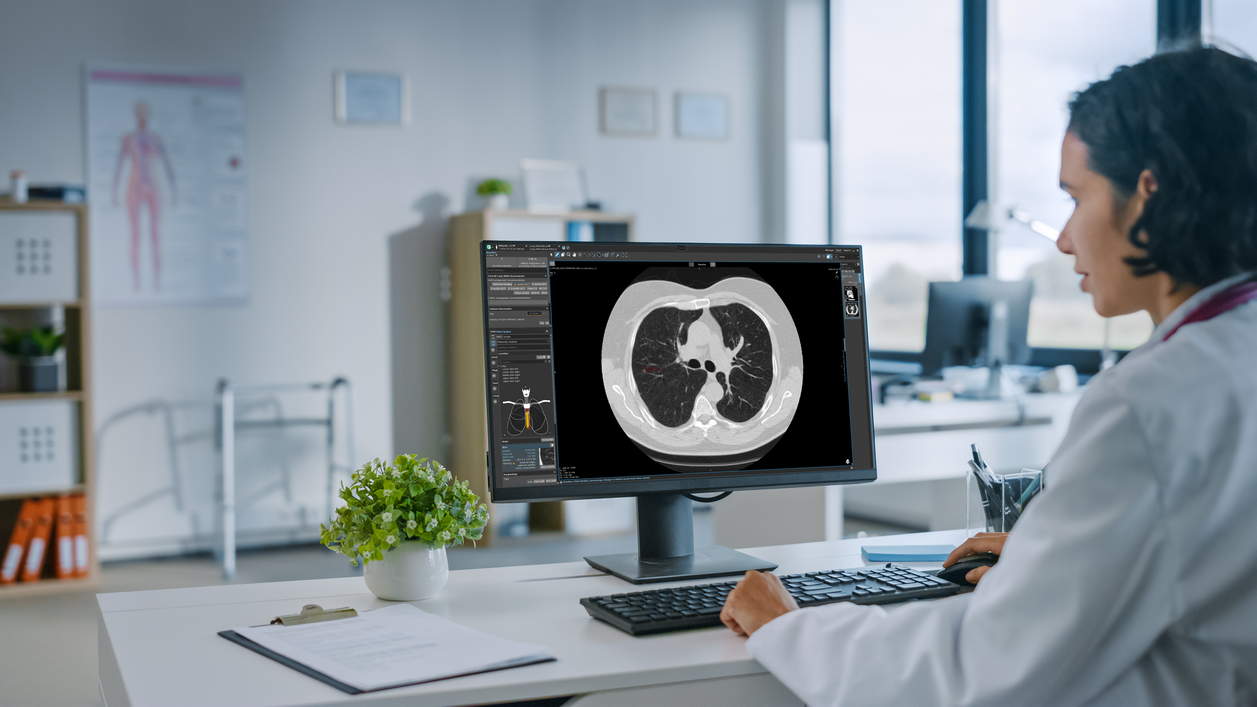
- Guided reporting: mint Lesion supports radiologists in systematically capturing, documenting, and tracking findings.
- Data-driven value: Reports are automatically transformed into high-quality structured data – without additional effort.
mint Lesion transforms imaging data into valuable foundations for research and clinical decision-making
The software extracts all primary data directly from medical images and immediately links each measurement to its clinical context. This creates a comprehensive, digital model of the patient that reflects individual developments over time.
All information is combined with clinical endpoints and made available in real time for analytics and AI applications. The result is structured, machine-readable data in a semantic data model, standardized in FHIR format to ensure interoperability across systems.
At Mint Medical, we are committed to empowering our users with full access to their data through open standards, because we believe in the value of interoperable, FAIR data. With mint Lesion, there is no vendor lock-in – only truly accessible data that can be reused and integrated across systems and research environments.
The real-world data generated with mint Lesion create value on multiple levels: they support the quality assurance of clinical diagnoses and treatment recommendations, form the foundation for large-scale data analytics, and enable seamless integration with innovative technologies such as artificial intelligence.
Structured Reporting as a Key to the Future
The role of radiology extends far beyond image interpretation – it serves as a source of data, a hub of communication, and a foundation for clinical decision-making.
Structured reporting is central to this evolution, and with mint Lesion, it has become an integral part of modern clinical practice.
Discover how mint Lesion can turn your reports into valuable data and help shape the radiology of tomorrow. Contact us today!
[1] Ganeshan, Dhakshinamoorthy, Phuong-Anh Thi Duong, Linda Probyn et al. 2018 “Structured Reporting in Radiology.” Radiology Research Alliance 25: 66-73.
[2] Christlein, Daniel, Johannes Kast, Matthias Baumhauer. 2021. „Gegenwärtige Entwicklung in der Healthcare-Informationstechnologie: Auswirkungen auf die strukturierte Befundung.“ Radiologie 61: 986-994.
[3] Vosshenrich, Jan, Ivan Nesic, Daniel T. Boll et al. 2023. “Investigating the Impact of Structured Reporting on the Linguistic Standardization of Radiology Reports Through Natural Language Processing Over a 10-Year Period.” Imaging Informatics and Artificial Intelligence 33: 7496-7506.